The report about the Dove World Outreach Center in Gainesville, Florida planning to burn copies of the Qur’an has upset me because I see in these small minded people the same dangerous hate that Ray Bradbury in “Fahrenheit 451” and Orwell in “Nineteen Eighty-Four” warned us about. As a free country the United States enjoys the freedom of speech, but like all things actions, and speech, still comes with consequences. The freedom of speech gives you the right to speak your mind in a public it is quite literally the right to hold opinions without interference. It is the right to freedom of expression. It is not however carte blanch to extol hate without reserve or consequence.
Book burning is one of my great hates, right up there with destruction of art. It is truly the worst forms of censorship and most extreme demonstrations of ignorance that man has ever conceived. This is not the freedom of expression, but rather the repression of expression. I’m not going to go into how the Dove World Outreach Center is justifying their actions, you can check their 10 Reasons to Burn a Koran(sic) if you really want to. However, I don’t want to argue with this church or prove how wrong their reasons are. We already know that no matter the reason their actions come from a place of hatred and ignorance, expanding on the specifics won’t change anything.
No, what really needs to be discussed is how many people and religious institutions are taking this opportunity to fight hate and ignorance with love and understanding. As this small church prepares to become the figurative “firemen” of “Fahrenheit 451” larger Christian churches and Jewish temples are planning to read parts of the Qur’an this weekend to promote understanding and acceptance. I am proud that so many have responded to this act of hate with strong feelings and actions to the contrary. It gives me hope that the world takes a step closer to being a better place.
Wednesday, September 8, 2010


Monday, September 6, 2010
Questionable Advertising Monday: Gender Status Quo
Ah, advertising. It permeates every part of almost every society, from food to politics. We can't get away from it. It also happens to be one of the greatest perpetrators of racism and sexism. Unfortunately even in the twenty-first century still many a good advertising company has created one or two questionable ads.
This week’s ad is “Growing Up Is...” for Nesquik and it comes from the McCann Erickson agency in Portugal.
It’s a rather banal ad for the Nestlé product, but it's…
Well, see for yourself.


There is nothing obviously offensive about the ad, which makes sense as it is aimed at parents, but then there's nothing contemporary about it either. At best it is a lazy attempt to portray male and female children. At worst it is another reinforcement of the same old gender roles. Not only is the imagery sexist, but in the bottom corner of each ad is a list of what “Growing Up Is…” for each sex. Girls get the usual princessy type stuff: caring for animals, kissing, and cake while boys get the usual manly type stuff: space ships, aliens, and …eating dog food? So according to this ad girls are princesses and boys are “special.”
I find it exasperating that this agency couldn’t move beyond breaking children down into their pre-assigned gender roles. Maybe they would have been better off sticking with the bunny.
This week’s ad is “Growing Up Is...” for Nesquik and it comes from the McCann Erickson agency in Portugal.
It’s a rather banal ad for the Nestlé product, but it's…
Well, see for yourself.


There is nothing obviously offensive about the ad, which makes sense as it is aimed at parents, but then there's nothing contemporary about it either. At best it is a lazy attempt to portray male and female children. At worst it is another reinforcement of the same old gender roles. Not only is the imagery sexist, but in the bottom corner of each ad is a list of what “Growing Up Is…” for each sex. Girls get the usual princessy type stuff: caring for animals, kissing, and cake while boys get the usual manly type stuff: space ships, aliens, and …eating dog food? So according to this ad girls are princesses and boys are “special.”
I find it exasperating that this agency couldn’t move beyond breaking children down into their pre-assigned gender roles. Maybe they would have been better off sticking with the bunny.
Friday, September 3, 2010
Awesome Book Review Friday: Pink Brain, Blue Brain
Because a little literature can go a long way I will be posting a review of an awesome book every Friday.
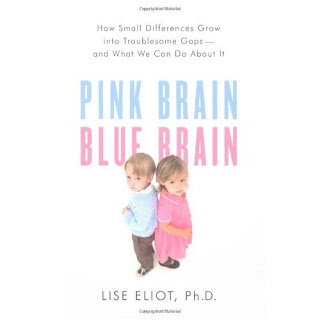
This week's book is "Pink Brain, Blue Brain: How Small Differences Grow Into Troublesome Gaps And What We Can Do About It" by neuroscientist Lise Eliot.
It's a non-fiction book that explores, and disproves, the science of proving gender exists naturally. The chapters are separated by childhood development, starting at birth and finishing at teenage hood.
It would have been enough for Eliot to simply disprove the studies or expose the misinformation, but she takes it a step further. At the end of every chapter is a break-down of how you as a parent or teacher can actually work to help children develop without the constraints of genderization.
My favorite example of this is in the beginning chapters of the book where Eliot exposes the myth that gender can be effected through superficial means, such as toys or clothes. She gives the example of giving dolls to boys and trucks to girls. She points out that this method is doomed from the start because it doesn't address the real problem. Worst it often leads parents to believe that gender is natural.
Instead of simply swapping genderized items, Eliot suggests that parents should first focus on what each sex lacks due to gender constraints. For example she points out that girls rarely get to develop their spacial abilities while boys rarely get to develop their nurturing abilities. If a parent really wanted to help their children overcome gender barriers they would instead give their girls building toys, like Lego or K'Nex, and allow their boys to care for a small animal.
At times with Eliot's scientific approach to the source material the chapters can seem overwhelming. However, it is well worth giving this book a read through. I found that while I may not always understand the studies she discuses in the chapters, there is more than enough information and instruction at the end of each chapter to make up for it.
If you are a parent, teacher, gender studies student, or you just care about breaking gender barriers, Lise Eliot's "Pink Brain, Blue Brain" is read worth picking up.
Friday, August 27, 2010
The Problem With Unpaid Internships
There has been a huge stir lately in America over the legality of unpaid internships. It has been great for the discourse and all sorts of discussions are popping up. (Check out the response to the Times article on unpaid internships at Cartoon Brew and the subsequent comments underneath.) The biggest debate that has come out of this is whether or not the internships are worth it. This isn't really the issue, since the real problem is that unpaid internships are slave labour. I feel that most commentators who are in favor of unpaid internships ignore a very important point which is: "What will this cost YOU? What will this cost OTHERS?"
In every case the ones who enjoyed an unpaid internship, by their own admission, were only working for a short time (doing things they enjoyed or were at least relevant) and soon received a paying job. I have to guess that it did not cost them much since they never discuss how tight things were. It is easy to see why they would paint all internships with the same rose coloured brush. But it also means that they have not even considered their own privilege when taking this kind of work.
What sets volunteer work apart from unpaid internships is access. As a volunteer I don't need to have previous experience or a degree and I get to set my hours. As an unpaid intern I am required to have qualifications and I am performing a job that should be paid. Already anyone who doesn't have the support to afford to work for free is excluded, because they would not be allowed to work AND have the internship.
A lot of what I'm hearing in defense of unpaid internships is something akin to fear mongering. It's a lot of "But if you don't take this job you may NEVER get a job anywhere!" or "When you're young you need to pay your dues so buck up and quit being picky!" These arguments totally ignore the fact that no one gets a job (or anything for that matter) they enjoy without being picky. We hear horror stories all the time about people settling for a job they needed rather than seeking a job they wanted and how they got stuck. Now imagine the same scenario only you aren't being paid! You only have one life. Why waste it because someone is trying to scare you into taking the first offer.
Here are some things you should think about when you are considering and unpaid internship.
1) Ask yourself: Why Should I Pay Them To Work?
No matter where you work you are going to have to spend money and time. There is a huge difference between volunteering at a theater two nights a week and volunteering at a publishing company 9-6 every day and some weekends, but it's very likely in the end both jobs will get you to the same place. One more job on your resume. Really think about it. These companies are getting more out of you than they give back. You wouldn't date a person who takes your credit card and always forgets your birthday would you?
2)Ask yourself: Why Do I Think I'm Worthless?
Many students devalue themselves to a ridiculous degree because they buy into lies that tell them they have no abilities. They often buy the line "I'm a student. What could I have to offer?" Well the answer is obviously something if someone is willing to let you into their office. If you were so valueless as an employee even volunteer groups wouldn't touch you. So start having some confidence in yourself and research what you should be paid at your level. Really think about your abilities and write them down. If you think you are lacking in something see how you can improve. It will go a long way. Not only will you be less likely to be taken advantage of, but you may find that the quality of the jobs you seek will improve.
3) Ask questions before you agree and get EVERYTHING in writing.
This is the most important step before agreeing to any work.
There seems to be this odd fear on the part of students about asking for the terms of employment. How can you be expected to do your job if you don't know what it is you should be doing? There are certain questions most employment counselors suggest you not mention until you have been offered the job. Mainly questions about pay and benefits. So while you shouldn't be bringing these up at the interview there's no reason you can't ask once you've been offered the position. In fact if you aren't asking these questions at all you could be giving yourself one huge headache in the future.
I know a lot of students who don't know the first thing about contracts and it is really hurting them. A contract isn't just about money. It's a layout of everything you agree to do for the company and everything the company agrees to do for you. Without one, you will essentially remain in the dark and that makes you easy to take advantage of and difficult for you to know if you are benefiting or not.
4) An Internship is a Job
Understand that internship is not another word for volunteer. A company must be clear with you from the get go if this is or is not a paid position. If you are under the impression that the internship is paid and the company has done nothing to tell you otherwise you MUST ask about the pay. Nothing could be worse than finding out two weeks into an internship that it is unpaid. If you ask about pay and suddenly the job offer disappears know that this is a warning sign. A company on the up and up would either have already told you it was unpaid or would have replied to your query.
Most important of all realise that you don't need that unpaid internship to get where you want to go. Sometimes avoiding them means you need to get more creative. However, this means that in the long run you'll have put in the same hours, but you'll have been reimbursed for your hard work.
And really that is what everyone deserves.
For more info check out 5 Tips for Handling Internships and What to do About Unfair Internships
Tuesday, August 24, 2010
I Loved My Barbie (And My Parent's Didn't Get It)

NOTE: does not depict typical use (image: Mark Ryden)
I loved my barbies growing up.
Well, let me clarify that. I loved my army of mohawked, tattooed amazons created from the many Barbie dolls I received as gifts.
But there was always a sort of contention surrounding the doll. I didn't know what the problem was until I was much older, but it always seemed like my parent's would have been happier if I had never touched the things in the first place.
At first they worried that I would get the wrong message from playing with the dolls. That somehow, from being exposed to the doll, I would come to believe that I should make myself look like her. Then, when I started to modify my barbies, they worried that I was going to treat people as badly as I treated my dolls. As if a child breaking a toy was unusual.
But really what did they know? Was it simply because of her vaguely human shape? Rainbow Bright is human shaped, but no one worries that their child will grow up to be a raver. As a child I never viewed Barbie as an example of femine beauty. I didn't dress like her because none of the women in my life were like that and she was a toy. Who wants to dress like their toys?
What I liked about Barbie was I could edit the hell out of her. I was free to change her however I wanted because she was designed so badly that her head would pop off after only a few brushes. I would hardly call that abusive. Besides, how did my parents know that she didn't want that tattoo of a giant eagle on her chest?
Ask any girl out there what she did with her barbies and I bet you anything she'll talk about cutting her hair, giving her tattoos or making her clothes with scraps and pipe cleaners.
But that's not what adults and parents think of when they see Barbie. They see a child playing with a Barbie and they think either, "That child is buying in to cultural femine norms." or inversely, "that child hates the cultural femine norms Barbie represents."
We really don't give credit to children at all. Worse this is basically Evolutionary Psychology at it's worst. There is no actual proof in any of these articles that girls "mutilate" a barbie doll because they are rejecting a stereotype. They "mutilate" these dolls because they fall apart easily. An adult may look at a Barbie and object to her underlying message, but a child looks at a Barbie and sees a blank canvas.
That's not to say that Barbie dolls don't carry dangerous baggage about feminity. They do, but then so do a lot of things in our society. It's a toy people! It only carries damaging baggage when parents encourage their girls to act like Barbie. It's more important that children have healthy and living role models and that they are allowed to treat a Barbie for what it is, a toy. Too often I hear about parents worrying over what it means when their child rips up and "mutilates" a Barbie doll. They feel like they should punish their girls for treating the doll badly. Like the doll is an actual person and they fear that this means that their girls will be violent against real people.
It's outrageous. If your child knowingly harms an animal that is an indicator that they will probably harm people. If your child modifies a toy because it fell apart that is healthy creative play. You know, the thing that makes them more likely to work out tough problems in adulthood? It also means that they won't hold up Barbie as any sort of ideal or model. If they did they would probably have never taken the toy out of the box to begin with.
Children are destructive. They like to take things apart to see how they work. They like to put their personal stamp on the things they own. To demand that a girl not treat her barbies like the toys they are only reinforces the concept that the Barbie model is somehow important. Which as so many adults like to point out, it's not.
Thursday, August 19, 2010
Workplace Harassment
A few years ago I was a manager at a production company with a pretty even male/female split. When I started I loved working there because we had a great team of people and everyone respected one another. However, about two years in I started to get reports about sexual harassment. I figured it would be a quick fix since our department manager was very serious about harassment cases. We carefully screened our new hires and we make them fully aware that physical or verbal harassment of any kind was not allowed. Those who got it stayed and those that didn't were let go.
However, this case was different. Because in this case the victims were men and the perpetrators were women. It seemed that some women felt that "playful" touching and "teasing" was okay and despite being asked to stop would continue without abate. I received repeated complaints, and it always made me sad because the men seemed so ashamed that they had to complain in the first place.
Talking with the women didn’t help as none of them believed what they were doing was sexual or harassment. Even pointing out that when someone says stop they need to stop didn’t work. They honestly believed that nothing they could do, short of grabbing the guys junk, counted as sexual harassment. This is not what feminism is about. We are not supposed to create a role reversal, but rather have respect for one another and listen when someone says no.
When it became clear to me that talking and shifting schedules wasn’t working I took the issue to the department manager. He didn't believe it and refused to listen, claiming that a woman couldn't possible sexually harass a man. I was floored. We eventually lost a good deal of employees because the work environment had grown so toxic. I also eventually left because I couldn't continue to work in a place that didn't treat every employee with respect.
The biggest issue with this whole incident was simply that men aren't raised to see women as threats and women are raised to believe they cannot be a threat to a man. Men are not taught to view unwanted attention as creepy or indicative of possible violence the way women are. If a man acts like these women he is perceived as being a possible threat, but when a woman does it she is perceived as either being pathetic or flirty.
Neither of these behaviours are healthy for anyone involved. Men don’t speak up enough when they feel uncomfortable, for fear of being labelled a sissy or weak. Women engage in sexual misconduct because they don’t believe that what they are doing is wrong or at all similar to what men do. This belief is only reaffirmed when managers and employers treat cases of male sexual-harassment with less seriousness than female sexual-harassment.
Monday, August 16, 2010
Parental Advice: Is It Helpful?
As I begin the move from university grad to full-fledged adult, i.e. getting a job, I have been inundated with advice from my parents. Sometimes the advice comes when I'm only looking for support. But most of the time it comes when I'm discussing strategies. I think like all parents, mine give advice in the sort of way that brooks no argument. Of course they are right, they're parents. The thing is when you become an adult you start to realize that maybe your parents aren't the font of wisdom they think they are.
I clearly remember letting my Dad look over my first university paper. It took a ton of work and he said it was definitely an A. So then you can imagine my utter (and inevitable) disappointment when I received a big fat C.
At first all I could think was "but my Dad said it was an A!" I then stared to realize that parents are people, and people have opinions, and opinions should not be treated as facts. Now my father is a history professor so it wasn't like he didn't have the credentials to mark a paper. He's constantly marking student papers while writing his own. I figured he would be a great judge of what would take to write a great paper. But he was in history where I was in English and Visual Arts, and it really came down to he didn't know what my professors were looking for.
And really that is where most of the bad advice from my parents comes from, they don't know anything about the field I'm in. My parents are both well educated professionals, but neither of them knows the first thing about grant applications or how a theatre union works. While I realize that there are certain things that can be applied to any job hunt I would never presume to tell a engineering grad or a psychology grad how to look for a job or apply for a job specific to their career.
It may surprise you to know (because I was surprised when I found out) that almost every career track has its own way of doing things, from everything up to and including the resume. Actually the resume is a good example of what I am talking about. The resume format that is commonly taught is the general business model. It's good for everything from McDonald's fry cook to general office assistant, however once you start thinking of a specific career like theatre tech or graphic artist things get a lot different. Google "theatre tech CV" or "graphic artist resume" you'll see what I'm talking about. Resumes are tailored to each area. So what works for one won't work for all, but when you have parents who know nothing about your career track it's makes the advice you're getting even more confusing.
Case and point. In live production (well any place really) who you know will get you in to a job for which you might otherwise be passed over. But you have to let the employer know who you know. In my Mom's line of work you don't write it, you call after you send your cover letter and resume to let the employer know. I almost lost out on a job because I took my Mom's advice on this. In live production you just out and say, in your cover letter, "Bob Thompson said you were looking." But she didn't know that and neither did I, because I wasn't asking the people in my field for advice. Now I always check with someone in my field if I am unsure of what to do, but it doesn't make it easier to tell my parents they don't know what they are talking about.
I think this is because your whole life they have been an unquestionable authority. And it's worked until adulthood because you aren't doing anything outside of their knowledge zone. But when you become an adult and take a career path they are totally unfamiliar with, suddenly their advice seems foisted upon you, without your consent. Failure to follow their advice will ultimately lead to sighs about "if only you had listened." It makes you want to scream, "No, you need to listen! Your advice doesn't help for this type of job!"
Parental advice isn't useless, if you are entering a similar job market. However, when you're going where they've never even thought of before, you’re pretty much on your own.
Subscribe to:
Posts (Atom)